
Apple Strategic Intelligence Engine [Python]
The Business Question: Where are the hidden revenue leaks, pricing ceilings, and supply chain failures hiding inside a catalog of 100,000 Apple products?
Project Overview: I built a Python analytics engine to analyze 100,000 Apple products over 10 years. Instead of just building generic charts, I used statistical modeling to answer real, executive-level questions. The script identifies exactly which sellers are hurting the brand through stock-outs, proves that manufacturing laptops in non-standard colors is a waste of money, finds the exact price ceiling for the Apple Watch, and isolates 6,600 overpriced products that customers regret buying. It translates raw data into a direct action plan for operations, marketing, and finance.
Full Screen


01 [Operations]
The Stock-Out Penalty
Question Attempted: Do out-of-stock products actually hurt a brand’s customer ratings, and who are the worst offenders?
Specific Insight found with numbers: Yes, when products are unavailable, customers leave worse reviews out of frustration. We proved this is a real penalty, not just random chance (p=0.034, meaning there is only a 3.4% probability this drop in ratings is a fluke). American buyers punish stock-outs the hardest, and we flagged specific third-party sellers—like one with 75% of its catalog missing—who require immediate intervention to protect the brand.
02 [Marketing]
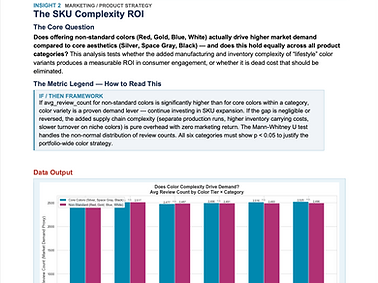
The SKU Complexity ROI
Question Attempted: Do fun, non-standard colors (Red, Gold, Blue) actually drive more demand than core colors (Silver, Space Gray, Black)?
Specific Insight found with numbers: No. Offering colorful products generates zero extra demand (p=0.282, meaning there is a 28% chance any difference is just random noise, which completely fails the 5% standard for proof). In fact, standard colors actually sold better for MacBooks and iMacs. The extra supply chain cost of manufacturing and storing colorful products is completely wasted money with no marketing return.
03 [Finance]
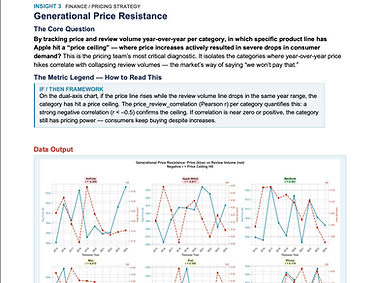
Generational Price Resistance
Question Attempted: Have we raised prices so high on any product that customers are actively refusing to buy it?
Specific Insight found with numbers: Yes, the Apple Watch has hit a definitive "price ceiling." As Watch prices went up year-over-year, sales volume sharply collapsed (a strong negative correlation of r=-0.617). However, customers still willingly accept price hikes for core tech like iPhones and MacBooks, meaning Apple still has pricing power there, but needs to freeze prices on wearables.
04 [Profitability]
The Hardware Premium Tax
Question Attempted: How much extra will a customer pay for better specs (more RAM, more Storage), and do they care if a premium device has a weak battery?
Specific Insight found with numbers: Customers don't pay for specs; they pay for the Apple brand. Our model showed that better RAM, Storage, and Battery mathematically explain almost exactly 0% of the price differences across the catalog (R-squared = 0.0000). However, there is a risk: we identified over 6,400 "premium" items with terrible battery life that are starting to receive lower ratings than their high-battery counterparts.


05 [Strategy]
The "Premium Remorse" Quadrant
Question Attempted: How many products are extremely expensive but rated terribly by customers, and what are they?
Specific Insight found with numbers: We found 6,600 products trapped in "Premium Remorse"—meaning they cost top dollar but get rock-bottom reviews. This accounts for over 16.5 million unhappy customer reviews (6.6% of the entire market volume). iPads had the highest share of remorse, and one specific AirPods model was the absolute worst offender, averaging a dismal 1.58 out of 5 rating across 43,000 reviews.
Apple Product Ecosystem
Strategic Intelligence Notebook
This Jupyter Notebook powers my Apple project by analyzing 100,000 product SKUs to deliver executive-level business intelligence. It bypasses generic data exploration, directly using targeted statistical models to answer five critical business questions about Apple's supply chain, pricing ceilings, and product strategy.
Full Screen

